Blogs
Master the latest industry news and real-time updates of the company
2025-06-18
The year 2025 marks the 25th anniversary of the Forum on China-Africa Cooperation (FOCAC) and is also the inaugural year for implementing the outcomes of the 2024 FOCAC Beijing Summit. This year commemorates the 25th anniversary of FOCAC, under whose guidance China-Africa relations have achieved leapfrog development. China has established strategic partnerships with all 53 African countries with diplomatic ties, trade volume between China and Africa has increased nearly 30 times, and Chinese investment in Africa has grown nearly 100 times, bringing tangible benefits to the peoples of China and Africa.
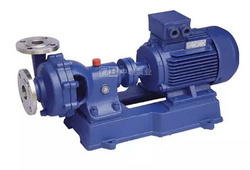
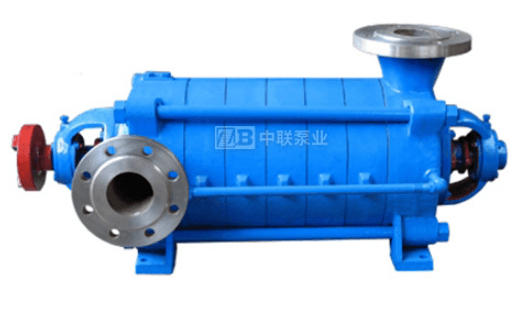
Horizontal Multi-stage Booster Pump
The horizontal multistage booster pump is a horizontally mounted, single-suction, multistage, segmental/sectional centrifugal pump featuring an advanced and rational design. It boasts high efficiency, excellent anti-cavitation performance, minimal vibration, smooth and reliable operation, and an extended service life. Primarily designed to convey clean water or other liquids with physical and chemical properties similar to water, this pump can also be adapted for handling hot water, oils, corrosive fluids, or media containing abrasive particles by modifying the material of its flow components, adjusting the sealing configuration, and incorporating an additional cooling system.
05
2025-09
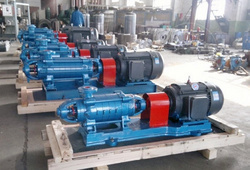
Corrosion- and Wear-Resistant Centrifugal Pump
In industries such as non-ferrous metallurgy, building materials, environmental protection (including desulfurization and flue gas desulfurization), and coal chemical engineering, centrifugal pumps are frequently used to handle abrasive or corrosive solid-liquid two-phase flows. In addition to the general performance characteristics of pumps, corrosion- and wear-resistant centrifugal pumps must also meet the stringent requirements imposed by the unique properties of the media being conveyed—for instance, many of these media contain sulfuric acid, hydrochloric acid, hydrofluoric acid, metal ions, and substances with a pH range of 5 to 6. As a result, the pump must exhibit excellent corrosion resistance and reliable sealing capabilities. Meanwhile, certain media have high concentrations, and particles near the bottom wall tend to have lower random velocity averages compared to those farther away from the bottom, which can easily lead to blockages—thus necessitating careful consideration of how concentration affects pump performance. Additionally, some liquid media contain solid particles that can cause erosion and abrasion in the flow passages; therefore, the pump's design and material selection must account for minimizing wear rates. Furthermore, for certain media with temperatures ranging between 65°C and 85°C, the impact of temperature on pump performance cannot be overlooked.
05
2025-09
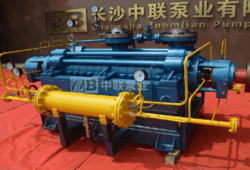
High-Temperature, High-Pressure Pump
Currently, high-temperature, high-pressure pumps are increasingly being used in fields such as petrochemicals, metallurgy, power generation, synthetic fibers, food processing, and mining. They are essential for equipment requiring high pressure accuracy or in experimental setups, where they handle the transportation of various media that operate under extreme temperature and pressure conditions.
Given the inherently high-temperature and high-pressure characteristics of the media being transported, selecting and designing these pumps demands rigorous standards. This includes stringent requirements for the strength of flow-path components, sealing mechanisms, and even the overall structural design to ensure reliable performance under demanding operational conditions.
05
2025-09
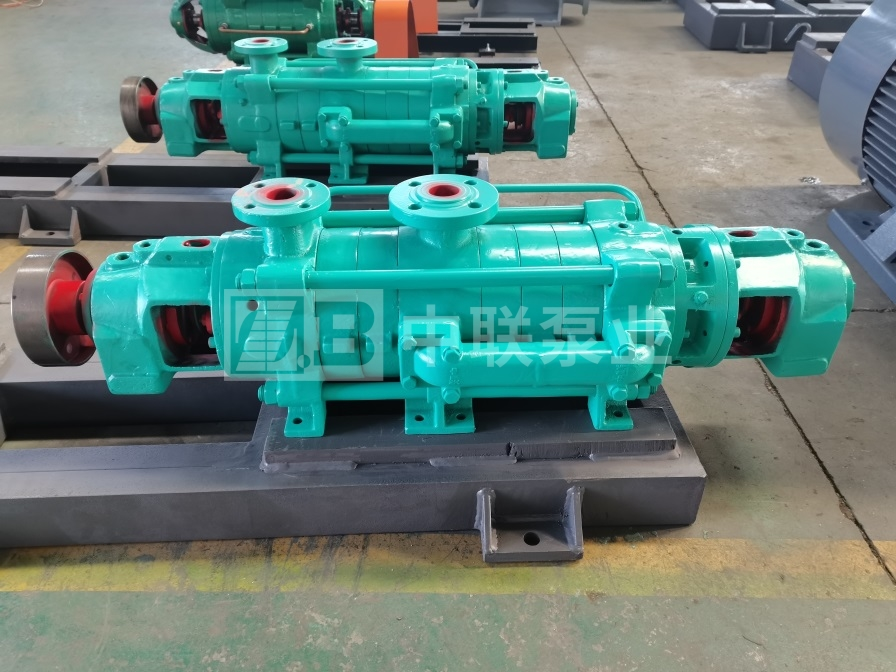
Type D Horizontal Multistage Centrifugal Pump
The D pump series features horizontal, single-suction, multistage, sectional centrifugal pumps that boast high efficiency, a wide performance range, safe and stable operation, low noise levels, long service life, and convenient installation and maintenance.
D-type pumps deliver flow rates ranging from 3.7 to 1,350 m³/h and can achieve head pressures between 49 and 1,800 meters. They are designed for conveying clean water or other liquids with physical and chemical properties similar to water.
Additionally, by modifying the material of the pump’s wetted components, adjusting the sealing configuration, or incorporating an enhanced cooling system, these pumps can also handle hot water, oils, corrosive fluids, or media containing abrasive particles.
The product complies with the JB/T 1051-93 standard titled "Types and Basic Parameters of Multistage Clean Water Centrifugal Pumps."
05
2025-09
The steam drum serves as the crucial link connecting the three key processes of working fluid heating, evaporation, and superheating, ensuring proper water circulation within the boiler. Meanwhile, the boiler itself is a quintessential example of a complex thermal control system. Among its critical parameters, the water level in the boiler drum is essential for maintaining safe and stable operation. Moreover, it acts as a vital indicator of whether the mass balance in the boiler's steam-water system is maintained. Keeping the boiler drum water level within the specified range is one of the primary indicators of normal boiler operation.
05
2025-09
The high-pressure ash water pump is auxiliary equipment supporting the washing and slag-handling processes in the pressurized coal-water slurry gasification unit. It is used to convey media—specifically, coal-ash-containing water—from the ash water treatment section. A portion of the low-pressure ash water, after being recovered via steam stripping from the deaerator tank, is sent back for recirculation in the gasification scrubbing tower, while the remaining part serves as emergency quench water, backflushing water for the slag-lock valve, and pressurizing water for the lock hopper, ultimately feeding into the gasification section. This process enables the efficient recycling of ash water.
(In the coal-water slurry gasification process, the scrubbing tower ash water pump pressurizes the ash water, which is then directed to the coal gas scrubbing tower. The ash water subsequently flows into a sedimentation tank, where it’s pumped by the ash water pump to the deaerator. From there, the ash water passes through a filter screen before being reintroduced into the ash water circulation pump, completing one full ash water cycle.)
05
2025-09