

-
Products
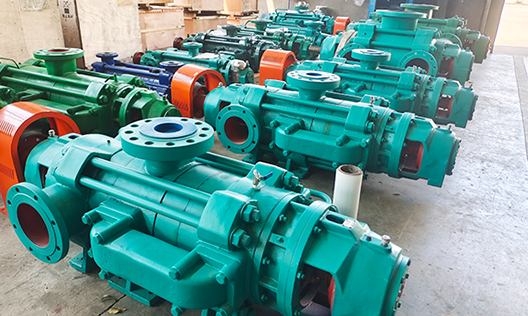
Puede fabricar 26 series de productos, incluyendo bombas de circulación para grandes centrales eléctricas, bombas de condensación para grandes centrales eléctricas, bombas petroquímicas, bombas multietapa, bombas de aguas residuales y lodo, bombas multietapa autoequilibradas, bombas de doble succión y única etapa tipo split, y bombas centrífugas de succión simple y única etapa.
-
Cases
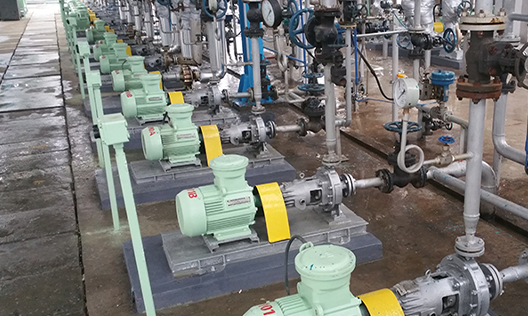
La elección de más de cientos de miles de clientes, cubriendo industrias como minería de carbón, metalurgia, química, energía, recursos hídricos, alimentos, municipalidades y protección ambiental, y exportando a Asia Sudeste, África, América y otros lugares.
-
Service
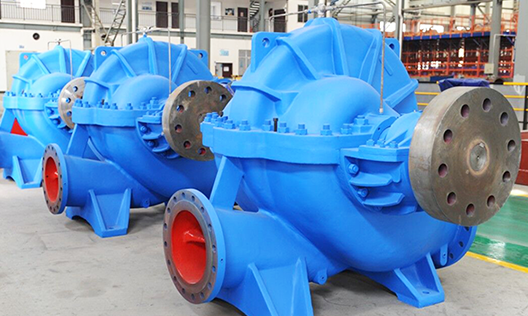
La empresa fue la primera en la industria en obtener las certificaciones internacionales del sistema de calidad ISO 9001:2008, del sistema de gestión ambiental ISO 14001 y del sistema de gestión de seguridad y salud ocupacional GB/T 28001, además de la certificación API 610 de la Asociación Estadounidense del Petróleo.
-
About us
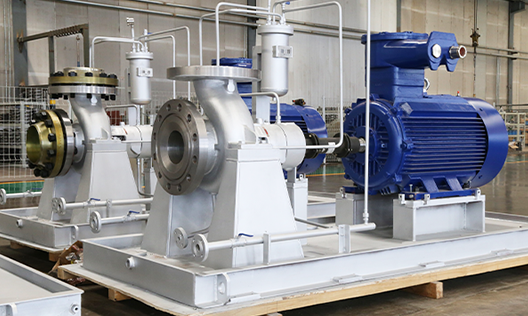
La empresa, fundada en 1989, es una empresa nacional de alta tecnología integral que integra diseño, investigación y desarrollo, fabricación y servicios; actualmente es una empresa clave en la industria china de bombas centrífugas y una de las grandes fábricas especializadas.
-

Blogs
Con productos innovadores, calidad excepcional y servicios integrales, buscamos la verdad y la pragmática, avanzamos con iniciativa, y nos esforzamos por lograr el objetivo de ser "la marca líder en el campo de aplicación de bombas centrífugas en el país"! Raigada en Hunan, orientada a todo el país y hacia el mundo!
Technical Analysis of the Causes of Insufficient Flow in Multistage Centrifugal Pumps and a Troubleshooting Plan
Publication Date:
2026-06-21
Author:
Source:


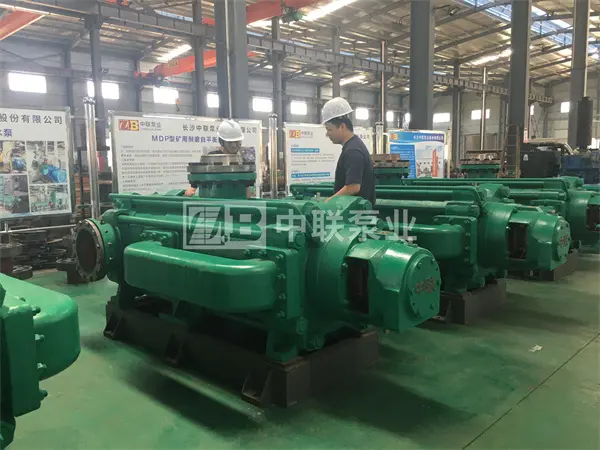
Insufficient flow in multistage centrifugal pumps is the result of coordinated interactions among design, operation, maintenance, and other factors. Below, Centrifugal pump Manufacturer Changsha Zoomlion Pump Industry This document provides a systematic technical analysis of the root causes of insufficient flow in multistage centrifugal pumps, along with a troubleshooting plan, for reference by user organizations.

I. Design Parameter Compatibility Issues
The flow rate design for multistage centrifugal pumps must be matched to system head, pipeline friction losses, and other relevant parameters. If the selected flow-rate parameters during the initial sizing stage—such as the rated flow Qn—do not meet the actual operating conditions—for example, when a network expansion results in a flow shortfall—or if a reduced-diameter impeller is used, leading to an insufficient effective flow area, the actual operating flow will deviate from the design value. It is recommended to verify the deviation between the actual demand and the design value through systematic flow testing in accordance with GB/T 3216-2016, “Test Methods for Centrifugal Pumps, Mixed-Flow Pumps, and Axial-Flow Pumps.”
II. Performance Degradation of Flow-Path Components
1. Impeller damage: During long-term operation, cavitation (due to insufficient net positive suction head, NPSH) or erosion can cause pitting on the impeller blades and increase blade clearances, directly reducing volumetric efficiency. It is necessary to use an endoscope to inspect blade surface roughness and runout (≤0.05 mm), and to assess the extent of damage by combining this with vibration spectrum analysis.
2. Guide-vane blockage: If medium crystallization (such as lime milk or syrup) or solid particle deposition occurs in the flow passages of the guide vanes in multistage pumps, local resistance coefficients will increase. It is recommended to disassemble and inspect the pump, measure the flow area of the guide-vane passages, and compare the measured value with the design value (allowable deviation ±5%).
III. Abnormal Resistance in the Piping System
1. Pipe diameter–length matching: Frictional head loss along the pipeline is inversely proportional to the square of the pipe diameter. If a DN50 pipe is used to convey a high-flow medium (e.g., Q > 200 m³/h) or if the total pipeline length exceeds 1.2 times the design value, the local head loss Δh may exceed 20% of the design value. It is recommended to verify the pipeline friction factor using the Hazen–Williams equation.
2. Valve characteristic deviation: Accessories such as check valves and gate valves, if subject to sticking or binding (e.g., due to valve plug wear resulting in insufficient opening) or operated at small openings (<30%), will incur additional throttling losses. The compatibility between valve opening and flow rate (Q–ΔP) must be verified.
IV. Interference in Gas–Liquid Two-Phase Flow
Failure of the multistage pump sealing system—such as aging of the mechanical seal O-ring or insufficient seal water—can allow air to ingress into the pump casing, forming a gas–liquid mixture. In such cases, it is necessary to monitor the relationship between the pump inlet pressure (P1) and the saturated vapor pressure (Pv); when P1 is less than Pv, cavitation is likely to occur. It is recommended to employ pressure sensors for real-time monitoring with an accuracy of ±0.02 MPa, combined with a redundancy assessment based on the design of the gas–liquid separation tank.
V. Drive Motor Parameter Mismatch
Insufficient motor power (e.g., when the prime mover’s rated power is less than 1.1 times the design value) or speed deviation (Δn > 5%) will result in pump shaft power P being lower than the design-condition value. It is recommended to verify, using the motor efficiency curve (η–Δn), whether the operating point falls within the high-efficiency region (η > 85%).
VI. Lack of Operations and Maintenance Management
1. Improper startup procedure: Failure to follow the “pump first, then valve” sequence results in the pump chamber being started before it is fully filled with liquid, leading to dry running and cavitation. The Pump System Operating Procedure (Q/SZZL002-2023) must be strictly adhered to.
2. Lubrication failure: Insufficient lubricant in the bearing housing or degradation of the lubricant (viscosity change exceeding 30%) will lead to an increase in the radial clearance of the bearing (exceeding 0.1 mm), causing eccentric vibration of the impeller and exacerbating flow fluctuations.
Recommended Information


Related Products
Perhaps you also want to know?
Zoomlian Pump Industry
Address:No. 210, Environmental Protection Middle Road, Yuhua Economic Development Zone, Changsha City, Hunan Province China
All rights reserved © Changsha Zoomlian Pump Co., Ltd.
This website supports IPv4 IPv6 bidirectional access
Website construction:Zhongqi Power Changsha