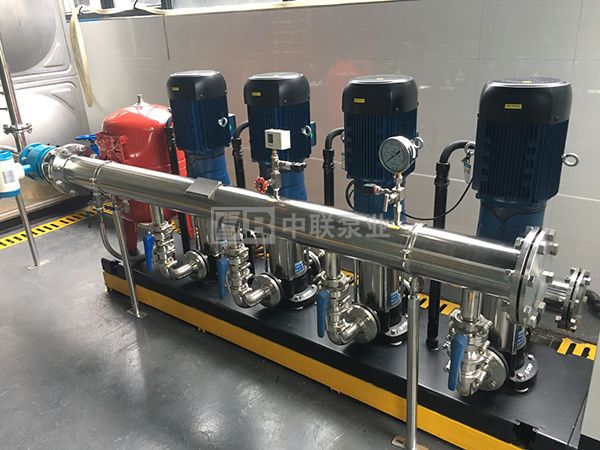
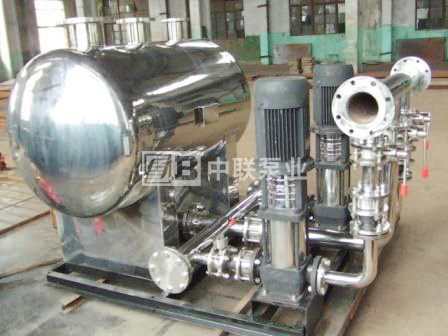
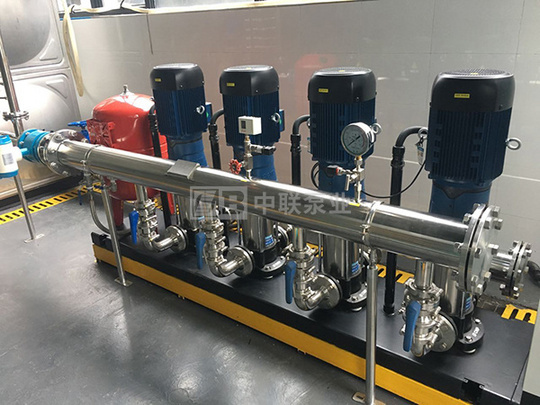
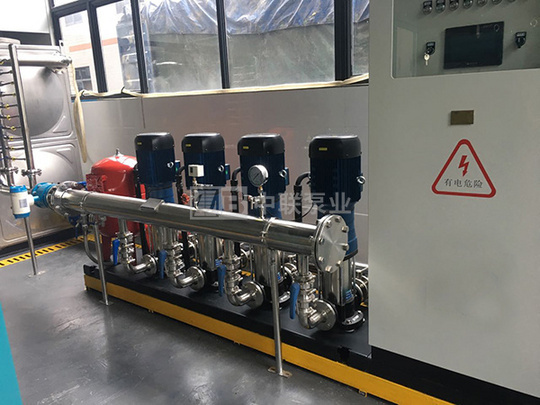
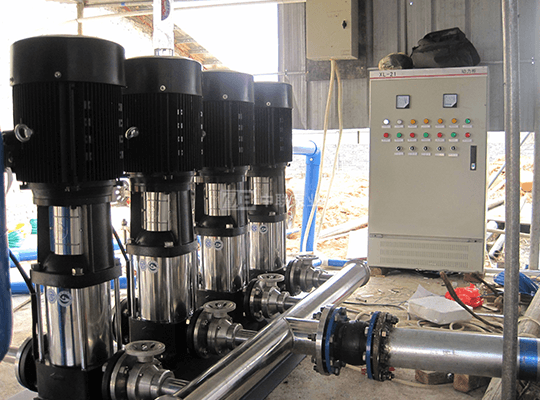
Composition of the water supply system and classification of the constant pressure secondary water supply system with variable frequency:
1. The variable frequency water supply equipment is connected to the municipal network for constant pressure water supply; when the water supply pressure meets the needs, all pumps stop automatically. Otherwise, the constant pressure water supply equipment is activated to increase the pressure and meet water usage requirements.
2. Additional operation of the small air tank with water supply without negative pressure and variable frequency.
3. Customized constant pressure water supply equipment with variable frequency. Repair and maintenance services for water pumps are also offered.
Equipment classification:
Popular water supply equipment in the market is divided into: variable frequency water supply equipment without negative pressure, variable frequency water supply equipment with deep well, constant pressure variable frequency water supply equipment, and variable frequency pump groups.
Variable frequency water supply equipment without negative pressure
Variable frequency water supply equipment without negative pressure consists of a stable pressure tank, water pump, negative pressure tank, and electrical control cabinet. Its outstanding advantage is that it does not require building water towers, the investment is small, it occupies little space, the layout is flexible, and the startup is quick. It uses automatic water and air adjustment, automatic operation, energy saving, and automatic connection to the drinking water network; it can supply water even after a power outage and does not require supervision after startup. It is widely used in enterprises, residential areas, and rural areas for production, life, and water supply in offices. It is suitable for users with less than 5000 households and a daily water supply of less than 3000 m3, with a supply height of more than 100 meters.
Constant pressure variable frequency water supply equipment
Constant pressure variable frequency water supply equipment is a new type of efficient water supply equipment. They use advanced microcomputer control technology, combining a frequency converter with a motor and water pump into a high-tech integrated electromechanical device that saves energy. The equipment adjusts the pump motor speed through automatic control of the frequency output of the converter, based on the water pressure at the pump outlet (or the user's water flow) as a set parameter, achieving closed-loop control of the pressure in the user's network. This automatically maintains the pressure stable at the set value: when water consumption increases, the frequency and speed of the pump increase; when it decreases, the frequency and speed decrease. This ensures that the user's network always has sufficient pressure (equal to the set value) and water volume (variable according to consumption).
Product features:
1. Overpressure, low pressure, overload, short circuit, phase loss, and low liquid level functions.
2. High adjustment accuracy, generally up to 0.01MPa, maintaining the system pressure constant at the set value.
3. Simple and convenient operation of the constant pressure water supply equipment, with automatic fault storage and fault display. The pressure can be set directly from the keyboard.
4. The constant pressure water supply equipment has the advantage of high energy efficiency; when used together with a pressure tank, the effect is better, with an energy saving rate of 20% to 50%.
5. Timed switching function of dual pump. Control of one in use and another on standby.
6. Compact structure of the constant pressure water supply equipment, occupies little space and is easy to maintain.
Variable frequency pump group
The variable frequency pump group equipment of the JHB series developed by Changsha Zhonglian Pump Industry uses imported frequency converters and small control cabinets, which are easy to equip; it only needs to install the control cabinet anywhere. This cabinet has no structural or formal requirements for the connected pumps, it only needs the converter to be compatible with the motor. After installation and adjustment, the equipment can operate without supervision. The variable frequency pump group is suitable for a small number of users and projects such as hotels.
Operating principle and characteristics of the constant pressure secondary water supply equipment with variable frequency:
The variable frequency water supply equipment first sets the supply pressure value according to user requirements, then energizes to operate. The pressure sensor monitors the network pressure and converts it into an electrical signal sent to the programmable controller or microcontroller. After analyzing the signal, it is sent to the converter to control the pump operation. When consumption increases, the output voltage and frequency increase, the pump speed increases, and the flow increases. When consumption decreases, the pump speed decreases to reduce the flow, maintaining the network pressure at the set value. In operation with multiple pumps, each pump is started smoothly in sequence, switching from variable frequency to fixed frequency until the pressure and flow are satisfied, achieving cyclic control of the pumps. During nighttime operation with low flow, the variable frequency pump maintains operation and can stop to conserve pressure.
1. No negative pressure
The system connects directly to the municipal network to take and pressurize water without causing negative pressure in the municipal water network.
2. Established pressure
By regulating the allowed pressure control valve, the allowed suction pressure in the municipal drinking water network can be established.
3. Assisted (or superimposed) pressure
When the allowed suction pressure and flow are exceeded, the pressure can be increased based on the municipal drinking water network pressure. Compared to suction from a common storage tank, this can reduce the number of pumps or decrease speed to save energy.
4. Constant pressure with variable frequency
The equipment detects the output pressure in real-time through sensors, compares the detected value with the established value to determine the number of motors and pumps in operation and the output frequency of the converter (which reflects the speed of the motor and pump), following the consumption curve to maintain constant pressure.
5. No noise
A modern design is adopted that fully considers current environmental demands, using special silent frequency converters and noise reduction techniques, so the system operates in ultra-silent mode.
6. Uninterrupted water supply during power outages
When there is a power outage in the supply line, the system uses methods such as BY PASS to ensure continuous water supply, automatically switching to the municipal network pressure during the outage.
7. High automation
The system can achieve fully automatic control, with manual/automatic switching functions, timed rotation of main and auxiliary pumps, pressure adjustment, constant pressure, protection against over and under voltage, protection against phase loss, protection against electrical leaks, overload protection, overheating protection, water shortage protection, compensation for leak detection, shutdown due to lack of use, and protection against instantaneous trips. Additionally, according to user needs, a human-machine interface can be configured for adjustment, monitoring, and visual remote maintenance.
Scope of application of the constant pressure secondary water supply equipment with variable frequency:
1. Water supply for living in new residential complexes, villas, offices, and integrated buildings.
2. Water supply for living in high-rise buildings, fire-fighting water use, high-end hotels, etc.
3. Renovation of traditional water supply systems such as air pressure supply and pressure boosting in surface tanks.
4. Cold water supply systems for boilers of all types and hot water for boilers.
5. Intermediate pressure pumping stations in drinking water plants and secondary pressure boosting of drinking water.
6. Water supply for production and living in various industrial and mining companies, and pressure stabilization in pipeline networks.
7. Circulating water supply systems and cooling water of various types.
8. Pressurized water supply for living and fire-fighting when the drinking water pressure does not meet the requirements.